You are here:

Digital Transformation Intelligence

Use External App Benchmarks To Inform Digital Capability Planning

Turn observable app capabilities, release patterns, experience themes and market context into structured evidence for CTOs, transformation leaders and enterprise digital teams.
Digital benchmarking I Capability gap context I API, dataset & managed delivery
Android App Data Scraping Services AppGators

Business Decisions & Outcomes

Make Digital Capability Planning More Evidence-Driven

Use structured external app evidence alongside approved client KPIs to improve benchmarking, period alignment and decision reporting without implying unsupported causation.

Custom Extraction Logic AppGators

Digital Benchmarking

Compare observable app capabilities and product patterns across a defined peer set.
Dedicated Workflows AppGators

Experience Comparison

Review customer-facing app experiences using release and feedback evidence.
Dedicated Workflows AppGators

Capability Gaps

Identify externally visible differences that may warrant deeper internal assessment.
Platform Specific Solutions AppGators

Transformation Evidence

Structure benchmark evidence for digital planning, investment and initiative review.

Business Challenges

What Makes Digital Transformation Planning Difficult To Benchmark?

Enterprise app intelligence requires more than source access. It needs consistent structures, operating workflows and delivery that fits the business requirement.
Fragmented Sources AppGators

Limited External References

Transformation teams may lack consistent outside evidence for comparing digital product capabilities.
Changing App Signals AppGators

Unclear Digital Capability Gaps

Observed competitor features do not automatically explain which internal capability should change.
Data Preparation AppGators

Disconnected Market Evidence

Features, release activity, review themes and regional presence often sit in separate research views.
Operational Continuity AppGators

Weak Planning Context

External evidence needs clear dates, comparators and interpretation boundaries to support planning responsibly.
Where App Data Comes From AppGators

Intelligence Decision Framework

Move From Planning Questions To Reviewable Capability Gaps

Keep the framework focused on the planning decision: define what needs to be understood, benchmark relevant apps, map observable capabilities, assess evidence-backed gaps and review initiatives.
01

Define Planning Question

Clarify the digital capability, experience or transformation question to evaluate.
02

Benchmark Apps

Select relevant apps, markets and external evidence for comparison.
03

Map Observed Capabilities

Organize feature, release, experience and market evidence into comparable capability areas.
04

Assess Gaps

Identify externally visible differences that require internal validation before action.
05

Review Initiatives

Use the benchmark context to support transformation and digital-product planning discussions.

Data Intelligence

Build Digital Capability Views From Observable External Evidence

Separate observed app evidence from derived interpretation and keep planning notes distinct from any internal maturity or systems assessment.
01

Feature Benchmarks

Documented product and feature evidence used to compare visible digital capabilities.
02

Release Cadence

Dated version and release activity used to understand external product evolution.
03

Experience Review Themes

Review-derived themes used as context around customer-facing digital experience.
04

Category Patterns

Category-level app evidence used to understand broader market patterns.
05

Regional Availability

Observed app or capability availability across selected markets or regions.
06

Dated Comparisons

Observation dates retained so transformation benchmarks remain time-bounded and reviewable.

External Signals & KPI Context Preview

Connect Capability Areas To Traceable External Evidence

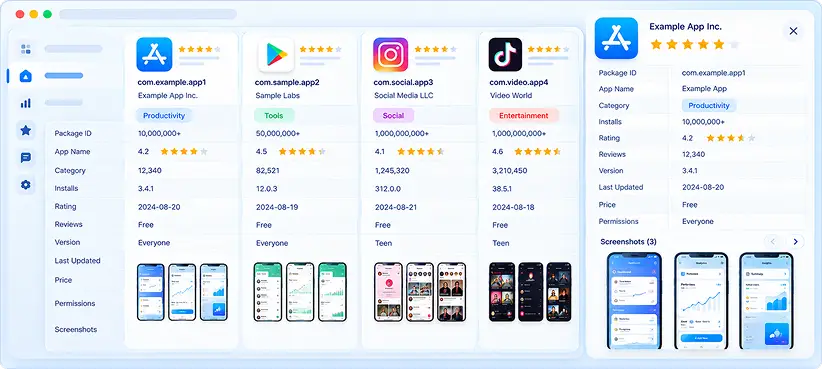
This sample demonstrates how digital capability areas can be organized with external benchmarks, observed evidence, gaps to assess, dates and planning notes.
Important : this is marked sample data, not a digital-maturity score, internal systems diagnostic or client result.

Industries & Use Cases

Apply Performance Intelligence To Decision Reporting

Use clearly separated external and internal evidence in recurring executive reporting, performance-context and competitive-benchmarking workflows.

01

Executive Reporting

Bring external app benchmarks into leadership reporting alongside approved internal measures.
02

Performance Context

Review external movement and client KPIs across aligned time periods without overstating causality.
03

Competitive Benchmarking

Compare external app signals against a defined peer set while retaining source and coverage context.

Delivery Options

Deliver Performance Intelligence Into The Workflow Your Team Uses

Supported delivery options, data scope and update cadence should be confirmed during requirements review.

API Delivery

For connected applications, BI systems and automated pricing workflows.

Custom Datasets

For pricing research, plan benchmarking and defined programs.

Cloud Delivery

For enterprise data platforms and downstream analytics.

Scheduled Feeds

For recurring price, plan and offer monitoring workflows.

Managed Delivery

For programs requiring ongoing collection and delivery support.

Trust & Proof

Built For Repeatable Enterprise Performance Context

Use documented workflows, quality controls and clearly bounded pricing evidence to support recurring plan and monetization comparisons.

Structured Workflows AppGators

Documented Workflow

Define measures, source types, periods and comparison rules before delivery.
Quality Controls AppGators

Quality Controls

Use validation, period-alignment and provenance checks to support consistent comparisons.
Competitive Intelligence Capabilities AppGators

Flexible Delivery

Support API, datasets, feeds, cloud and managed paths where confirmed.
Competitive Intelligence Capabilities AppGators

Operational
Continuity

Support recurring programs as external signals, KPI inputs and reporting periods evolve.
Sample Deliverable AppGators

Approach & Evidence Note

Proof Should Demonstrate Source Separation, Not Unsupported Performance Attribution

Use an approved external-signals-and-KPI-context sample or anonymized implementation example once the supporting asset is ready.
Important : No revenue inference, retention inference, causal attribution, client logo, accuracy percentage, SLA or performance gain is represented in this sample.

Frequently asked questions

Business Performance Intelligence Questions

These answers are intentionally conservative for the design prototype. Final coverage, cadence and source-specific commitments should be confirmed during scoping.

How is pricing comparison scope defined?

Mobile app intelligence helps businesses monitor app performance, competitor movements, ratings, reviews, and market trends to support product decisions.

Mobile app intelligence helps businesses monitor app performance, competitor movements, ratings, reviews, and market trends to support product decisions.

Mobile app intelligence helps businesses monitor app performance, competitor movements, ratings, reviews, and market trends to support product decisions.

Mobile app intelligence helps businesses monitor app performance, competitor movements, ratings, reviews, and market trends to support product decisions.

Mobile app intelligence helps businesses monitor app performance, competitor movements, ratings, reviews, and market trends to support product decisions.

Mobile app intelligence helps businesses monitor app performance, competitor movements, ratings, reviews, and market trends to support product decisions.

Mobile app intelligence helps businesses monitor app performance, competitor movements, ratings, reviews, and market trends to support product decisions.