You are here:

Business Performance Intelligence

Place External App Signals Alongside Approved Internal Performance Measures

Bring external app benchmarks and client-supplied KPIs into a clearly separated comparison view for BI, analytics, product and executive decision support.
External benchmarks I KPI context I API, dataset & managed delivery
Android App Data Scraping Services AppGators

Business Decisions & Outcomes

Make External And Internal Performance Context Easier To Review Together

Use structured external app evidence alongside approved client KPIs to improve benchmarking, period alignment and decision reporting without implying unsupported causation.
Custom Extraction Logic AppGators

External Benchmarks

Compare observed app ranks, ratings, review trends, pricing and product changes across a defined peer set.
Dedicated Workflows AppGators

Trend Context

Align external signals to matching observation periods so movement can be reviewed in context.
Dedicated Workflows AppGators

Performance Mapping

Place approved client-supplied KPIs alongside external evidence while keeping data types clearly separated.
Platform Specific Solutions AppGators

Decision Reporting

Structure comparison views for BI, analytics and executive review workflows.

Business Challenges

What Makes Performance Context Difficult To Interpret?

Enterprise app intelligence requires more than source access. It needs consistent structures, operating workflows and delivery that fits the business requirement.
Fragmented Sources AppGators

Siloed External Signals

App-store and market signals often sit separately from internal performance reporting.
Changing App Signals AppGators

Unclear KPI Context

External evidence can be misread when client KPIs and source types are not clearly labeled.
Data Preparation AppGators

Inconsistent Periods

Comparisons become unreliable when external and internal measures use different observation windows.
Operational Continuity AppGators

Unsupported Causal Conclusions

External movement alone cannot establish revenue, retention or business causation.
Where App Data Comes From AppGators

Intelligence Decision Framework

Move From Separate Measures To Comparable Performance Context

Keep the framework centered on the decision: define measures, align sources and periods, compare evidence responsibly and review what the combined context actually supports.
01

Define Measures

Specify external signals and approved internal KPIs relevant to the decision.
02

Align Data Sources

Label external app evidence and client-supplied measures separately.
03

Match Periods

Use comparable time windows and preserve source observation dates.
04

Compare Context

Review external and internal movement without treating correlation as causation.
05

Review Decisions

Use the combined context to support BI, analytics and executive discussion.

Data Intelligence

Build Performance Views With Clear Source Provenance

Keep external signals, client-supplied KPIs and interpretation notes visibly distinct so decision-makers can understand what each measure actually represents.
01

External Ranks

Observed app-store or category positions used as external benchmark evidence.
02

Ratings & Review Trends

Dated customer-facing evidence used as contextual external signals.
03

Visible Pricing

Observable app pricing or plan evidence used where relevant to benchmarking.
04

Dated App Changes

Version, listing or product changes preserved with observation dates.
05

Client-Supplied KPIs

Approved internal measures included only when supplied and authorized by the client.
06

Source Provenance

Source type, time period and coverage context retained for every measure.

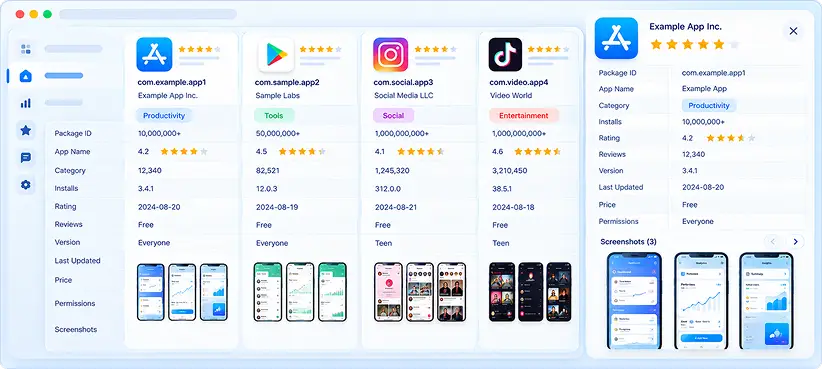
External Signals & KPI Context Preview

Place External Benchmarks Beside Approved KPI Context Without Blurring Their Meaning

This sample demonstrates how external app signals and optional client-supplied KPIs can be aligned by period while preserving source type, comparator, coverage and interpretation notes.

Important : This is marked sample data, not a self-service product, j,client result or causal performance claim.

Industries & Use Cases

Apply Performance Intelligence To Decision Reporting

Use clearly separated external and internal evidence in recurring executive reporting, performance-context and competitive-benchmarking workflows.

01

Executive Reporting

Bring external app benchmarks into leadership reporting alongside approved internal measures.
02

Performance Context

Review external movement and client KPIs across aligned time periods without overstating causality.
03

Competitive Benchmarking

Compare external app signals against a defined peer set while retaining source and coverage context.

Delivery Options

Deliver Performance Intelligence Into The Workflow Your Team Uses

Supported delivery options, data scope and update cadence should be confirmed during requirements review.

API Delivery

For connected applications, BI systems and automated pricing workflows.

Custom Datasets

For pricing research, plan benchmarking and defined programs.

Cloud Delivery

For enterprise data platforms and downstream analytics.

Scheduled Feeds

For recurring price, plan and offer monitoring workflows.

Managed Delivery

For programs requiring ongoing collection and delivery support.

Trust & Proof

Built For Repeatable Enterprise Performance Context

Use documented workflows, quality controls and clearly bounded pricing evidence to support recurring plan and monetization comparisons.

Structured Workflows AppGators

Documented Workflow

Define measures, source types, periods and comparison rules before delivery.
Quality Controls AppGators

Quality Controls

Use validation, period-alignment and provenance checks to support consistent comparisons.
Competitive Intelligence Capabilities AppGators

Flexible Delivery

Support API, datasets, feeds, cloud and managed paths where confirmed.
Competitive Intelligence Capabilities AppGators

Operational
Continuity

Support recurring programs as external signals, KPI inputs and reporting periods evolve.
Sample Deliverable AppGators

Approach & Evidence Note

Proof Should Demonstrate Source Separation, Not Unsupported Performance Attribution

Use an approved external-signals-and-KPI-context sample or anonymized implementation example once the supporting asset is ready.
Important : No revenue inference, retention inference, causal attribution, client logo, accuracy percentage, SLA or performance gain is represented in this sample.

Frequently asked questions

Business Performance Intelligence Questions

These answers are intentionally conservative for the design prototype. Final coverage, cadence and source-specific commitments should be confirmed during scoping.

How is pricing comparison scope defined?

Mobile app intelligence helps businesses monitor app performance, competitor movements, ratings, reviews, and market trends to support product decisions.

Mobile app intelligence helps businesses monitor app performance, competitor movements, ratings, reviews, and market trends to support product decisions.

Mobile app intelligence helps businesses monitor app performance, competitor movements, ratings, reviews, and market trends to support product decisions.

Mobile app intelligence helps businesses monitor app performance, competitor movements, ratings, reviews, and market trends to support product decisions.

Mobile app intelligence helps businesses monitor app performance, competitor movements, ratings, reviews, and market trends to support product decisions.

Mobile app intelligence helps businesses monitor app performance, competitor movements, ratings, reviews, and market trends to support product decisions.

Mobile app intelligence helps businesses monitor app performance, competitor movements, ratings, reviews, and market trends to support product decisions.