- Home
- Customer Intelligence
Digital Transformation Intelligence
Understand Expressed Needs And Compare Customer Feedback Patterns
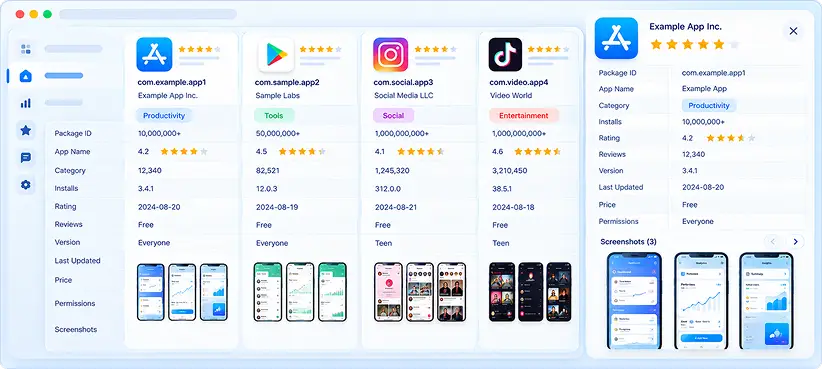
Turn regional app availability, category ranks, local feedback, visible pricing and publisher evidence into structured intelligence for market-entry and expansion research.
Business Decisions & Outcomes
Make Candidate Markets Easier To Compare With Traceable App Evidence
Market Comparison
Regional App Landscape
Local Feedback Context
Entry Evidence
Business Challenges
What Makes Market Expansion Research Difficult To Compare?
Enterprise app intelligence requires more than source access. It needs consistent structures, operating workflows and delivery that fits the business requirement.
Inconsistent Market Comparisons
Limited Local Context
Unclear Competitive Density
Missing Dated Evidence
Intelligence Decision Framework
Move From Candidate Markets To Reviewable Entry Options
Select Candidate Markets
Define Criteria
Collect Regional Signals
Compare Evidence
Review Entry Options
Data Intelligence
Build Digital Capability Views From Observable External Evidence
Feature Benchmarks
Release Cadence
Experience Review Themes
Category Patterns
Regional Availability
Dated Comparisons
External Signals & KPI Context Preview
Connect Capability Areas To Traceable External Evidence
Industries & Use Cases
Apply Performance Intelligence To Decision Reporting
01
Executive Reporting
Performance Context
Competitive Benchmarking
Delivery Options
Deliver Performance Intelligence Into The Workflow Your Team Uses
API Delivery
Custom Datasets
Cloud Delivery
Scheduled Feeds
Managed Delivery
Trust & Proof
Built For Repeatable Enterprise Performance Context
Use documented workflows, quality controls and clearly bounded pricing evidence to support recurring plan and monetization comparisons.
- Client KPIs remain clearly labeled as client-supplied inputs.
- External app signals are not presented as direct evidence of revenue, retention or causation.
Documented Workflow
Quality Controls
Flexible Delivery
Operational
Continuity
Approach & Evidence Note
Proof Should Demonstrate Source Separation, Not Unsupported Performance Attribution
Frequently asked questions
Business Performance Intelligence Questions
How is pricing comparison scope defined?
Mobile app intelligence helps businesses monitor app performance, competitor movements, ratings, reviews, and market trends to support product decisions.
What pricing sources can be included?
Mobile app intelligence helps businesses monitor app performance, competitor movements, ratings, reviews, and market trends to support product decisions.
Can coverage vary by market or plan?
Mobile app intelligence helps businesses monitor app performance, competitor movements, ratings, reviews, and market trends to support product decisions.
How often can pricing intelligence be updated?
Mobile app intelligence helps businesses monitor app performance, competitor movements, ratings, reviews, and market trends to support product decisions.
Does a listed price represent the actual transaction price?
Mobile app intelligence helps businesses monitor app performance, competitor movements, ratings, reviews, and market trends to support product decisions.
Can pricing outputs integrate with BI or analytics systems?
Mobile app intelligence helps businesses monitor app performance, competitor movements, ratings, reviews, and market trends to support product decisions.
What is the next step to scope a pricing intelligence program?
Mobile app intelligence helps businesses monitor app performance, competitor movements, ratings, reviews, and market trends to support product decisions.